
The Titanium Dioxide Effect
A Statistical Investigation of Kimi Antonelli's 2025 Season

Back in November, I published a quick analysis on LinkedIn investigating a fan meme that had been circulating in F1 communities: the theory that Mercedes rookie Kimi Antonelli only performs well in countries where titanium dioxide (E171) is permitted as a food additive. At the time, with 21 races complete and three remaining, the correlation was striking enough to warrant a closer look. The statistics were hilariously absurd.
Now the 2025 season is complete, and I’ve re-run the analysis with the final three races included. The effect not only held, but it strengthened in some measures.
So let’s do this properly.
The Premise
For the uninitiated: titanium dioxide is a white pigment used in foods ranging from candy coatings to salad dressings. The European Union banned it as a food additive in 2022 following an EFSA assessment that couldn’t rule out genotoxicity concerns. The United States, much of Asia, and various other jurisdictions still permit it.
Someone on Twitter (I’ve lost the original source, but credit to whoever mapped this out) noticed that Antonelli’s results seemed to cluster suspiciously well with this regulatory distinction. Good weekends in the US, Japan, Bahrain. Disasters in Italy, Belgium, the Netherlands. The meme wrote itself.
I am not, to be clear, suggesting that titanium dioxide consumption actually affects racing performance. But when presented with a testable hypothesis and 24 data points, sometimes you just have to run the numbers.
The Data
I collected Antonelli’s qualifying and race finish positions across all 24 rounds of the 2025 season, coding each venue by the TiO2 regulatory status of its host country. The sample split 14 races in TiO2-permitted countries versus 10 in TiO2-banned countries.
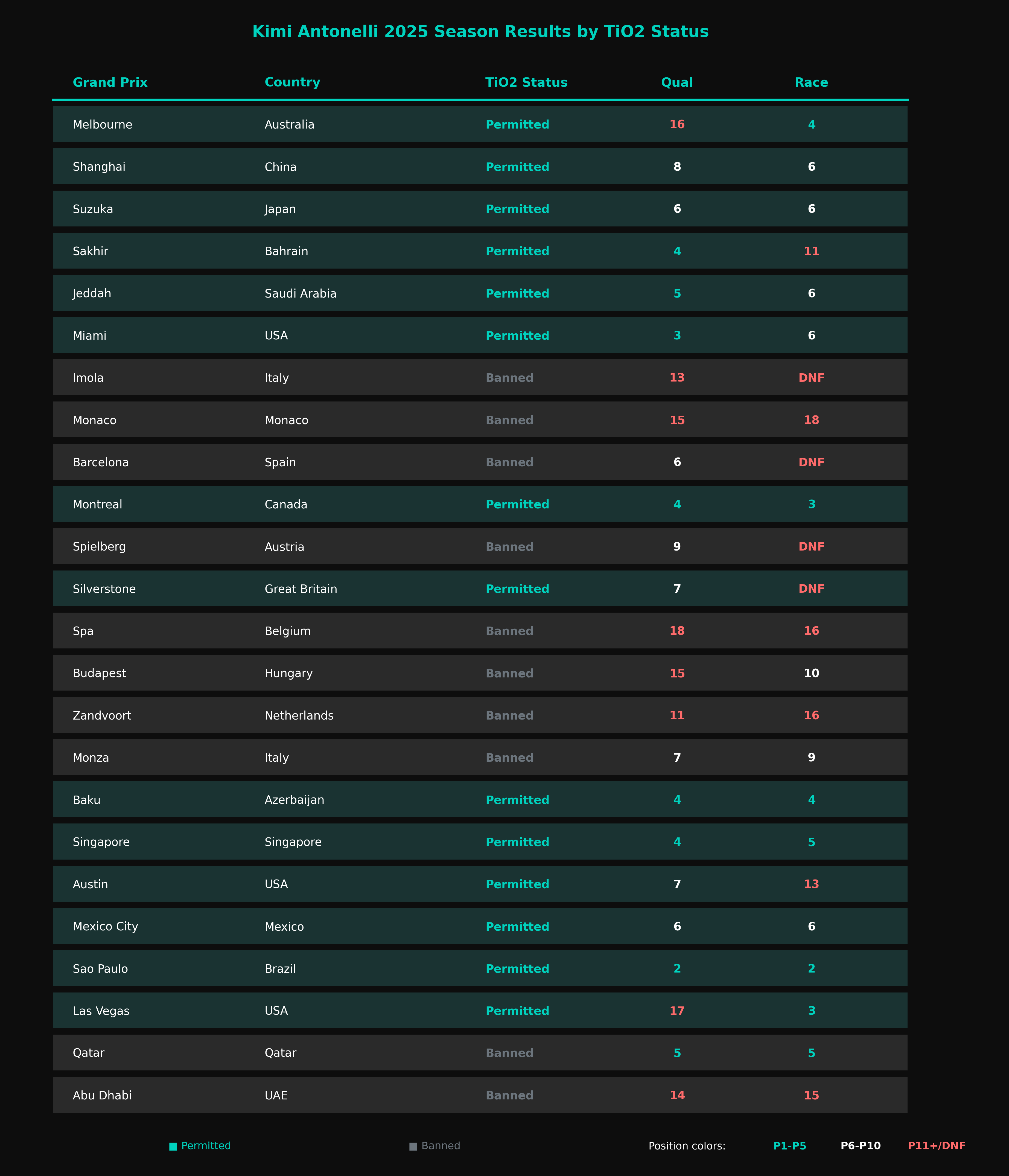
Even before running any statistics, the pattern is visible. The permitted-country rows are dominated by top-five and top-ten finishes. The banned-country rows are a collection of mid-pack struggles, back-of-grid qualifying sessions, and DNFs.
Statistical Analysis
Qualifying Performance
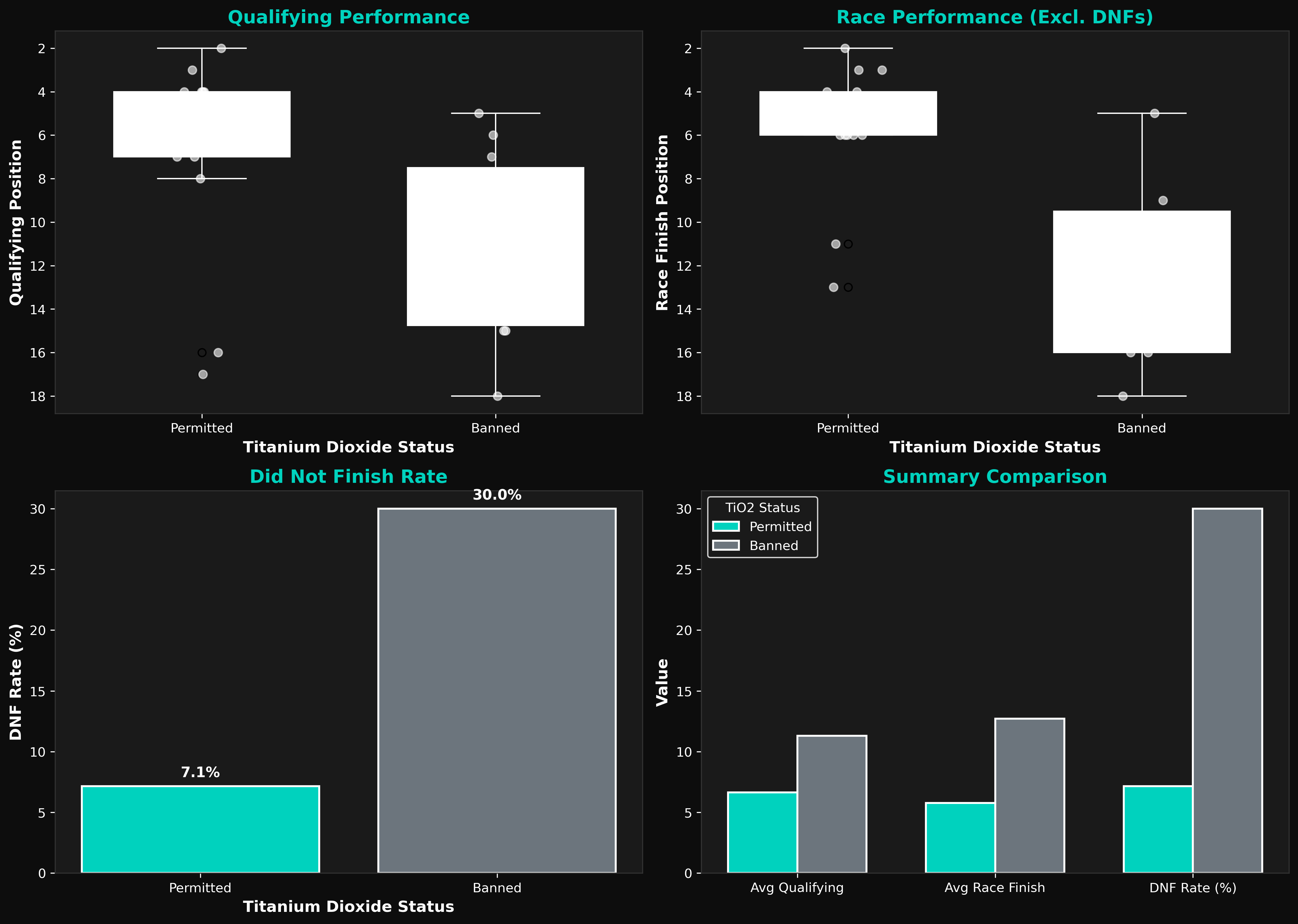
In countries where titanium dioxide is permitted, Antonelli qualified with a mean position of 6.64 (SD: 4.50). In countries where it’s banned, his mean qualifying position dropped to 11.30 (SD: 4.40).
The difference is statistically significant under both parametric and non-parametric tests:
t-test: t = -2.52, p = 0.019
Mann-Whitney U: U = 29.5, p = 0.019
Cohen’s d: -1.05 [95% CI: -2.80, -0.25]
A Cohen’s d of -1.05 represents a large effect size (the conventional threshold for “large” is 0.8). The confidence interval, generated via 10,000 bootstrap resamples, excludes zero comfortably.
Race Performance
The race results are even more dramatic. Excluding DNFs (which we’ll address separately), Antonelli’s mean race finish in permitted countries was 5.77 (SD: 3.11, n=13) compared to 12.71 (SD: 4.75, n=7) in banned countries.
t-test: t = -3.96, p = 0.0009
Mann-Whitney U: U = 11.5, p = 0.007
Cohen’s d: -1.86 [95% CI: -4.48, -0.88]
A Cohen’s d approaching -1.9 is enormous. If this were a pharmaceutical trial, we’d be writing up the results for publication. The entire confidence interval sits well beyond the large-effect threshold.
DNF Rate
Antonelli retired from 1 of 14 races (7.1%) in TiO2-permitted countries versus 3 of 10 races (30.0%) in banned countries. The chi-square test doesn’t reach conventional significance (χ² = 0.86, p = 0.35), but with only 4 total DNFs in the sample, we’re underpowered to detect anything but the most extreme differences. The direction is consistent with the overall pattern.
The Teammate Control
A reasonable objection: maybe the TiO2-banned countries just happen to host more difficult circuits, or Mercedes struggled at those specific venues for unrelated reasons. If that were true, we’d expect George Russell to show a similar pattern.
But he doesn’t.
Russell’s qualifying performance shows a modest trend in the same direction (mean 3.71 in permitted countries versus 5.40 in banned) but the difference doesn’t reach statistical significance (t = -1.78, p = 0.089). His race finishes tell a similar story: 3.64 versus 5.50, p = 0.078. The effect sizes are approximately half of Antonelli’s:
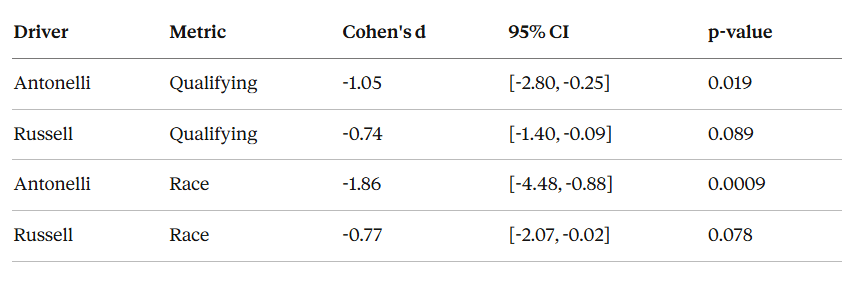
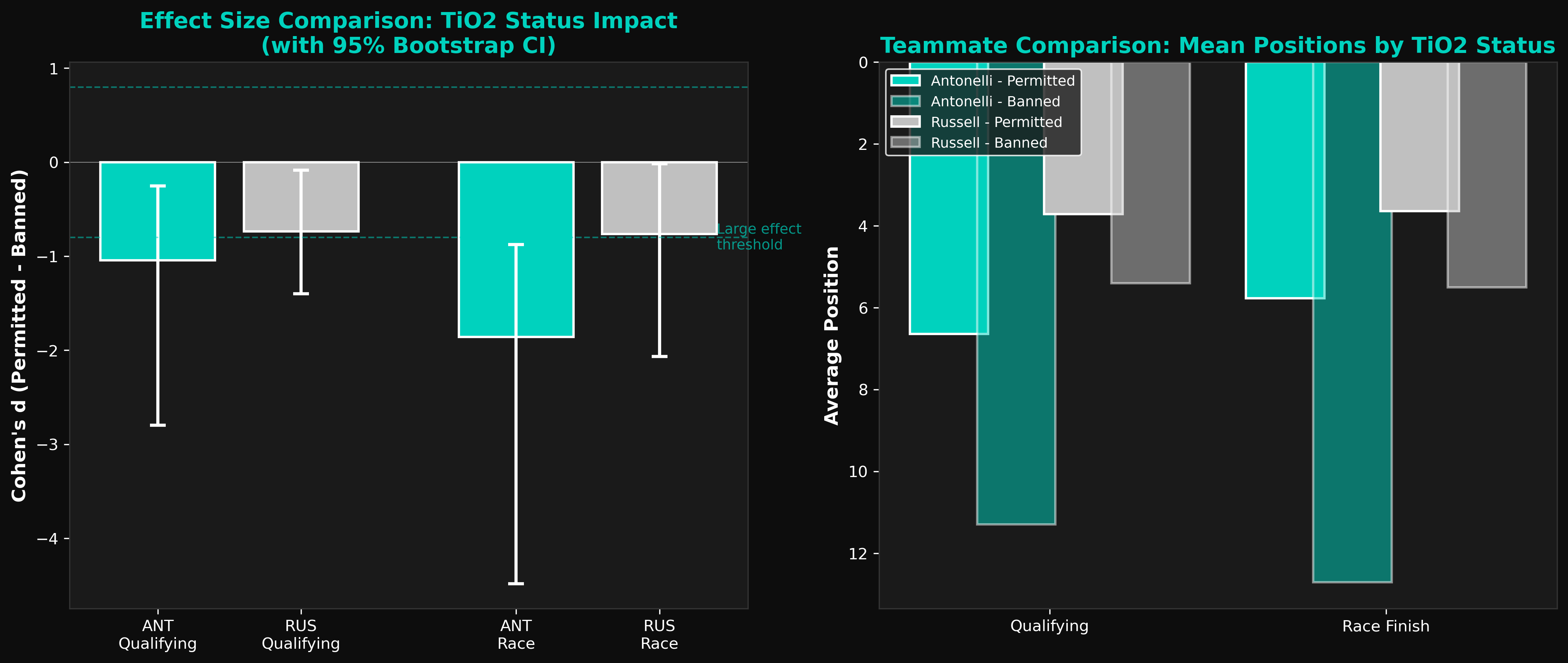
Russell does show some TiO2-correlated variation, as the confidence intervals overlap with Antonelli’s, and we can’t definitively claim his effect is zero, but the magnitude is clearly smaller, and critically, only Antonelli’s effects reach conventional statistical significance. Whatever is happening here appears to be Antonelli-specific.
Confounds and Caveats
Let’s be serious for a moment about what might actually be driving this pattern.
Circuit characteristics: The TiO2-banned countries in Europe host several technically demanding street circuits and tracks that historically favor driver experience. Monaco, Spa, Zandvoort, and the Hungaroring all appear in the “banned” column. A rookie struggling at these venues isn’t surprising.
Calendar clustering: The European summer stretch (Imola through Monza) falls almost entirely in banned-country territory. If Antonelli had a difficult mid-season development period (not uncommon for rookies) the regulatory correlation could be coincidental.
Sample size: 24 races, split 14-10, gives us limited statistical power. The confidence intervals on the effect sizes are wide. A few different results could have shifted the conclusions meaningfully.
Multiple comparisons: I ran several tests. If you test enough hypotheses, some will reach significance by chance. I haven’t applied formal corrections here because this is, fundamentally, not a serious proposition.
What This Actually Means
Nothing.
Correlation is not causation, titanium dioxide is not a performance-enhancing substance, and Kimi Antonelli’s struggles in Europe are almost certainly explained by the usual factors: track characteristics, development curve, circumstance.
But the numbers are what they are.
By conventional statistical standards, there is a significant association between food additive regulations and Antonelli’s 2025 performance. The effect is large, robust to non-parametric testing, and more pronounced for him than for his teammate.
The fan meme, against all reason, survived contact with actual data.
I said in November that I hoped the pattern would hold through the final three races because I love commitment to a bit. Antonelli delivered: P3 in Las Vegas (permitted), P5 in Qatar (banned—an outlier), and P15 in Abu Dhabi (banned). Two out of three isn’t bad for a fake hypothesis.
If Mercedes is reading this, I’m not saying you should adjust Kimi’s diet based on the race calendar. But I’m also not not saying that.